
Quantum noise in silicon: how the entropy cell works
Single electrons cross a deliberately leaky junction at moments physics makes unpredictable. We count them, test them and turn them into random numbers.
Every key, password and signature starts with a random number. If an attacker can predict that number, the cryptography built on top fails, however strong it is. Post-quantum algorithms replace the maths. They do not fix weak randomness underneath.
Where the randomness comes from
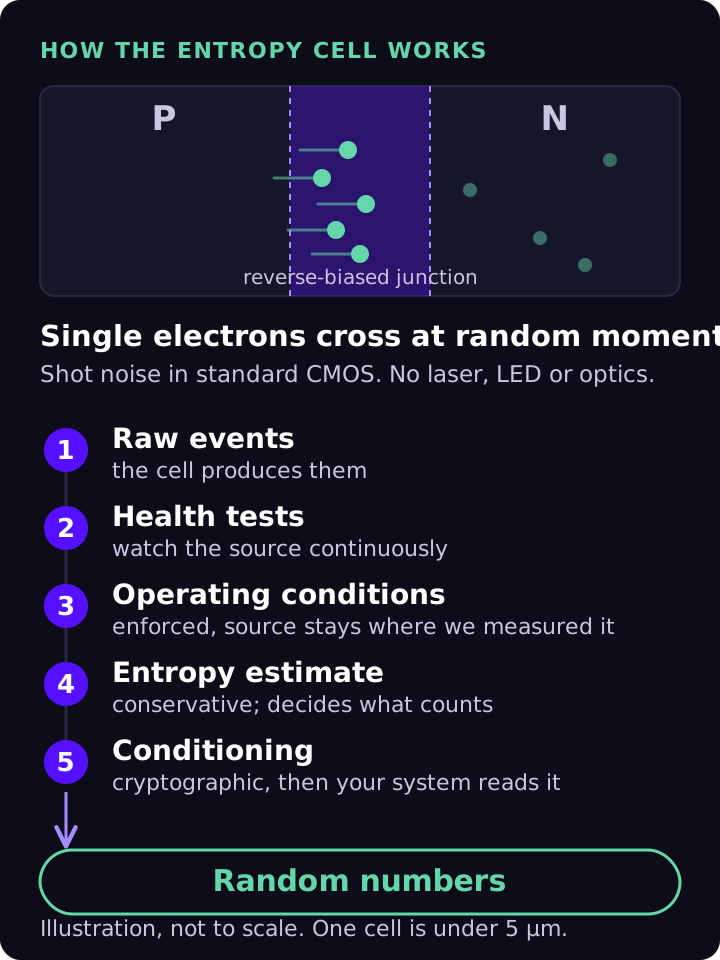
Our entropy source is a reverse-biased, deliberately high-leakage PN junction in standard CMOS. Defect-assisted transitions create single electron and hole pairs at random moments. This is a discrete, Poisson process: the time of the next event cannot be predicted, even in principle.
We count the electrons. There is no laser, no LED and no optics. It is shot noise in silicon.
From noise to random numbers
- The cell produces raw events.
- Continuous health tests watch the source while it runs.
- Operating conditions are enforced, so the source stays where we measured it.
- A conservative entropy estimate decides how much of the raw output counts.
- Cryptographic conditioning turns the result into the random numbers your system reads.
How small it gets
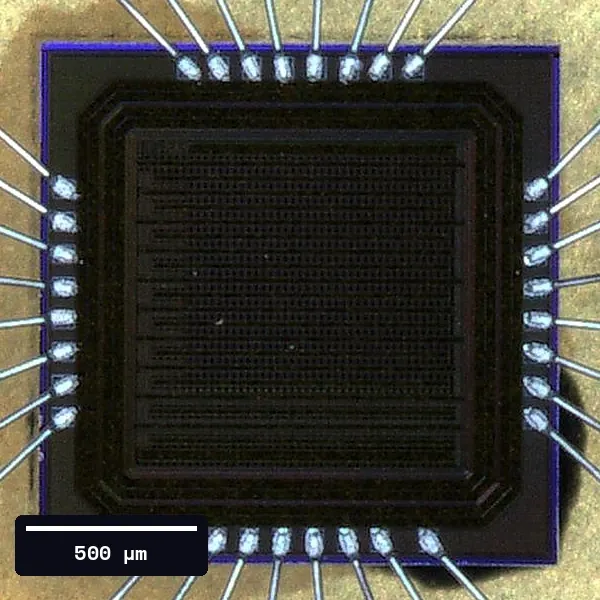
One cell is under 5 µm, smaller than a red blood cell. Cells work in parallel, so you add cells to add speed. The IoT-class integration block measures 100 × 100 µm. Today’s 1.5 × 1.5 mm die holds many more.
What we have measured
Our internal NIST SP 800-90B assessment gives about 0.99 bits of entropy per bit. That is our own assessment. Formal SP 800-90B validation and AIS 31 readiness are on our roadmap.
Explore VERA-Q shortlist access and VERA-T evaluation options.
Discuss your application
Share your requirements and the questions raised by this blog.
Discuss QRNG evaluation