
IN THE GUIDE
Questions to settle before integration.
- Where entropy is created and how it enters the system
- How health testing and conditioning fit into your design
- Which interface and evaluation approach suit your platform
- What to verify with your security and hardware teams
Choose an evaluation path
A quantum random number generator supplies physical entropy to the system that uses it. Evaluation also needs to consider the source's operating conditions, health tests, entropy assessment and conditioning. Our entropy-cell explanation describes that chain.
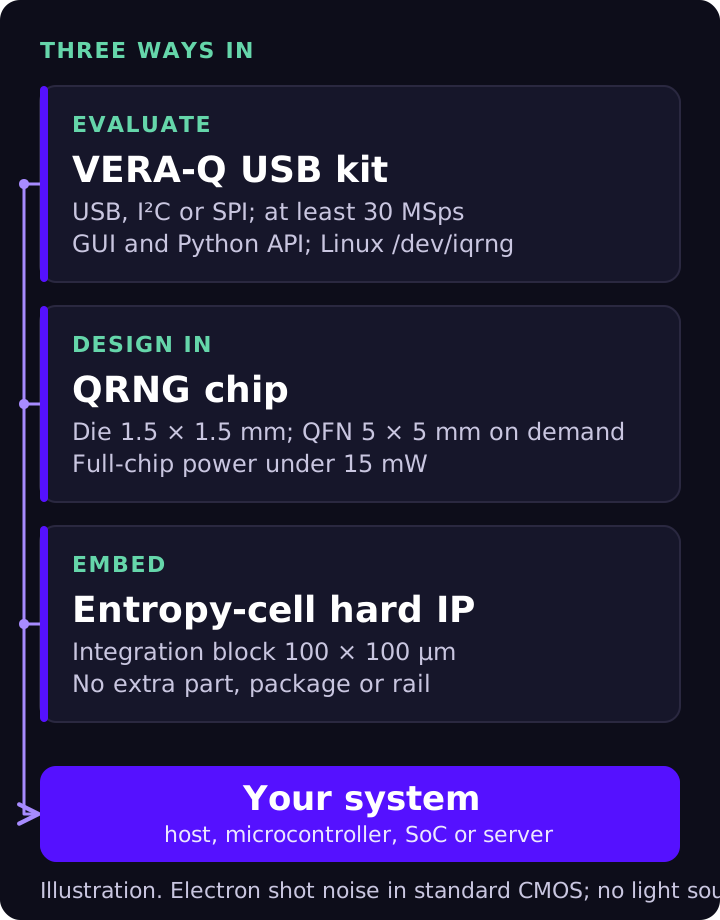
To explore the software stack, VERA-T is an available classical TRNG kit with the shared VERA GUI and API. Use the public software evaluation guide to plan host-communication and application-integration checks. To assess quantum-origin entropy, request VERA-Q separately through shortlist access. Compare the evaluation options; purchase or loan arrangements depend on volume and the business case.
For a practical comparison of the hardware paths, read USB QRNG, chip or IP: choosing an integration path.
Settle the system requirements before integration
Identify where your system consumes entropy, which interfaces it needs, and the operating conditions you need to evaluate. Agree on what will be measured at the source, after conditioning and at the system interface so that throughput and entropy-quality figures are compared at the same stage.
Then discuss a packaged QRNG chip or entropy-cell IP integration. The IP integration block is 100 × 100 µm; the individual noise cell remains under 5 µm. Product availability and integration arrangements require a technical discussion.
Request details are processed through Netlify Forms so the iQrypto team can respond to your enquiry. The request form does not subscribe you to marketing updates. Optional analytics have a separate accept/reject choice.
Prefer a technical discussion? Talk to the iQrypto team.